How much does a concrete driveway cost in Irving?
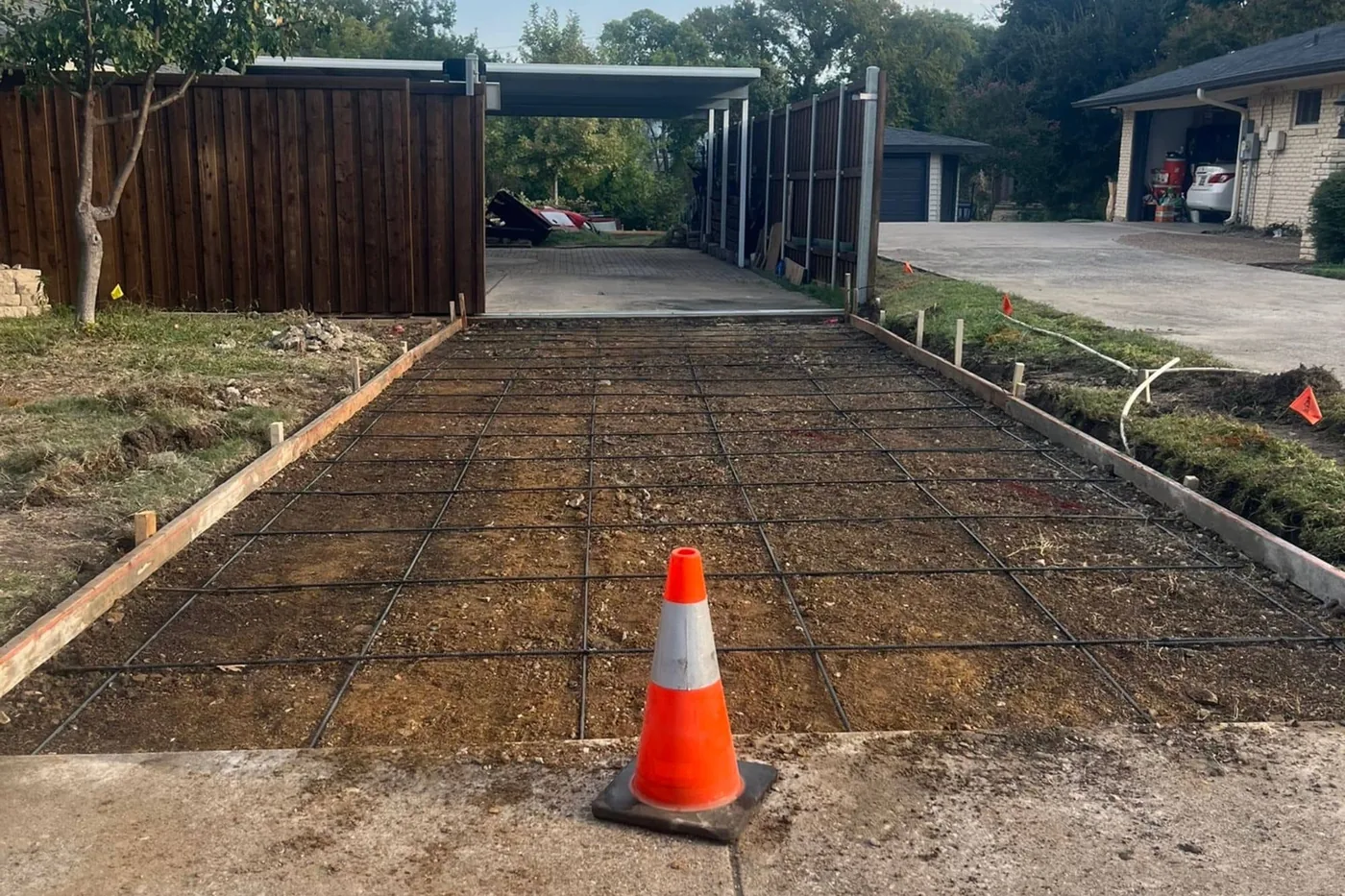
An Irving driveway runs above a bare flatwork quote because it is built for ground that moves: a compacted, moisture-conditioned base over Blackland clay, a reinforcement grid, deliberate joints, drainage suited to low ground near the river, and a cure that stands up to the heat. As a starting range, standard residential driveways tend to start around $8 to $14 per square foot, with decorative finishes or heavy tear-out pushing higher. From there the price follows square footage, thickness (4 to 6 inches), finish, and any demolition. We lock it in after walking the site, not over the phone.
How do you keep a driveway from cracking on Irving clay?
Two fronts: a reinforcement grid and a deliberate joint layout in the slab, and a compacted, moisture-conditioned base so the expansive clay isn't jacking the concrete up and dropping it as it wets and dries. We also grade to steer water off the edges, which counts double on the city's lower lots. This soil travels; our work is to set where it shows.
Why do driveways near the Trinity tilt and split over time?
The cause is almost always the clay underneath, not the concrete. On low ground the wet-dry swing runs hard: a long drought shrinks the soil and pulls support out from under whole sections, then a heavy rain swells it back, and a slab poured thin without a real base or steel tilts and cracks along that movement. We rebuild the base, the reinforcement, and the drainage so the cycle doesn't keep repeating.
How thick should a concrete driveway be?
Ordinary passenger vehicles get a pour in the 4 to 6 inch band, and we step up the thickness for RVs or heavier trucks. We size it to what actually parks there, not a single stock number.
When can I drive on a new concrete driveway?
Walk on it first, park on it later, since concrete keeps gaining strength long past the point it looks done. We hand you the specific dates for your pour up front, adjusted for how hot the week turns out.
Can you tear out and replace my old driveway?
Yes. We roll the tear-out, the haul-off, and the new pour into one quote. An old slab that has tilted, split, or drifted apart usually traces back to a base, reinforcement, or drainage shortcut, and we correct all three on the rebuild.